
And five specific roles I’d take if the right one came along
The job market in 2026 is broken in a specific way.
The roles people post don’t match the people who exist, and the people who exist don’t fit the categories the roles use. Recruiters filter on legibility. Founders hire on conviction. The gap between those two is where most of us are losing time.
If you’ve sent dozens of applications this year and gotten silence back, the problem probably isn’t you. It’s that you’re being read by a system designed to sort generalists into categories that don’t fit. Marketing or operations. Writer or builder. Strategy or execution. Pick one.
I’ve spent the last year refusing to pick one. This piece is what I’ve learned about how to hunt for work when you don’t fit a clean category, and the five roles I’d take in 2026 if the right ones showed up.
The frame is for you. The roles are for me. Both should be useful.
What a game of one actually is
The term comes from Naval Ravikant, who was riffing on older economic ideas about monopoly and category creation. The shape is simple: build a category where you don’t have competitors, because the combination of skills, taste, and obsessions you’ve assembled isn’t held by anyone else.
It sounds elegant in retrospect. It’s miserable while you’re playing it.
Games of one look like indecision in real time. Your friends think you’re scattered. Your parents think you’re lost. Your LinkedIn looks weird. You apply for jobs and the hiring manager can’t tell if you’re a marketer or an operator or a writer, so they default to a no.
The bet is that the world catches up. Somebody is eventually looking for exactly the combination you’ve built. The years of looking unfocused turn into the moat that makes you the only candidate.
I think it’s a real bet. I also think most people playing it have no framework for whether they’re actually playing it or just being scattered. Those two things look identical from the outside and feel almost identical from the inside.
So here’s what I’ve found useful for telling the difference.
How to actually find your game
The standard advice here is some version of “find the intersection of what you love and what you’re good at.” It’s true and useless. Anyone can generate that intersection by lowering the bar on both sides.
Better tests below. Each one ends in a concrete exercise, because the point of a framework is to do something, not to reflect.
The conviction test
Forget what you’re good at. What do you have an actual take on?
A take is a position you hold that you can defend in a long argument with someone smart who disagrees with you. It’s not a preference. It’s not a vibe. It’s a view of how the world works in some specific domain that you can articulate and back up.
The takes that signal a game of one are usually narrow and weird. Mine, for example: Doki Doki Literature Club is one of the best pieces of art made this century. I’ll defend that for an hour. It’s a horror game about visual novels that uses the medium itself as its weapon. Most people who’ve heard of it dismiss it. I think it’s a masterclass in what narrative design can do when it stops pretending to be a transparent window onto a story and starts treating the medium as a character. The fact that I have this take, in this much detail, about this specific work, tells me something about what I am at the core. I’m a narrative designer. Not a marketer who likes stories. A narrative designer who happens to also do marketing.
Your takes tell you what you actually are.
Do this: Write down five narrow takes you’d defend in a real argument. Not political takes. Domain-specific ones. The narrower and weirder, the better. If you can’t write five, you don’t have a game of one yet. You have interest, which is different. Spend a year having more arguments. The takes will come.
The boring task test
This one is older than I am. Cal Newport writes about it. Tyler Cowen writes about it. The shape: what are you willing to do the boring parts of?
Every domain has a glamorous surface and a tedious substrate. Writing has the glamour of finished essays and the tedium of revising the same paragraph for the eighth time. Building has the glamour of a working demo and the tedium of debugging a config file at midnight. Music has the glamour of performance and the tedium of practicing the same four-bar phrase for an hour to get the timing right.
People who win in a domain are people who can do the boring parts without resenting them. If you find yourself enjoying the substrate, that’s the signal.
For me, the marker is music. I can practice the same chord progression for two hours without getting bored. I can rewrite the same paragraph six times to find the right word. I can run the same audit pattern across five different companies and find it satisfying each time. These are the substrates I tolerate. They map directly to the work I’m built for.
Do this: Track yourself for one week. Note every time you do a tedious task without resenting it. The pattern that emerges is the shape of the substrate you can live inside. Career advice ignores the substrate. Your career is built out of it.
The compounding skills audit
Most career advice asks what you want to be good at. Wrong question. Better question: what are you already accidentally getting better at?
Make a list of the things you can do today that you couldn’t do two years ago. Not because you set out to learn them. Because life pushed you and you adapted. The skills that compound without your permission are the skills your real career is being built out of.
My version of this list, when I made it last year, included: prompt engineering, narrative structure, running a workshop, designing systems for messy human work, writing copy that sounds like a person, managing across cultures, hosting a room of strangers. I didn’t choose any of these deliberately. They accumulated. They’re now what every role I’d actually want requires.
Do this: Open a doc. Write today’s date at the top. Below it, write down ten things you can do now that you couldn’t do two years ago. Don’t filter for impressiveness. Include the small ones. Then look at the list and ask which three of these skills, if combined, would describe a category nobody else is in. That’s your game of one in draft form.
The intersection multiplier
Once you have your takes, your tolerated substrates, and your compounding skills, the game of one starts to draw itself.
You’re looking for the smallest intersection where all three overlap. Not the biggest. The smallest. The smaller the intersection, the harder it is to replicate, and the more valuable it is to someone who specifically needs it.
Sahil Bloom and others have written about this. The shape: three or four overlapping things you do at a higher-than-average level usually gets you to a combination nobody else has. That’s not because you’re a genius. It’s because combinations compound faster than depth. Being top-1% at one thing is hard and slow. Being top-25% at four things that nobody else has combined is reachable and creates real scarcity.
Do this: List five things you do at a higher-than-average level. Multiply them. Write the product as a single sentence describing a person. If the sentence sounds weird and specific, you’re on it. If it sounds like a job title, you’ve gone too abstract. Try again with more specific inputs.
The audience test
The last test is the one most people skip. Once you have a candidate game of one, ask: who is this for?
Not in the abstract. Who specifically, by name or by archetype, needs this combination of things?
If you can’t name a person or a type of person, the game is too abstract. You’ve described a hobby. If you can name three people who specifically need exactly what you do, the game is real. Find a fourth and a fifth, and you have an audience.
For me, the audience is education founders building AI-native programs, technical founders who need a marketing operator with narrative taste, and game studios doing speculative worldbuilding. That list took me a year to clarify. The clarity changed how I read every job description after that.
Do this: Write down the names of three real people, or three specific archetypes, who would benefit from exactly what your game of one offers. If you can do that, you have a real audience. If you can’t, your game is still a candidate and not a position. Iterate.
My four modes
Here’s what mine look like, in roughly the order of how deep each one goes.
The narrative architect
I build worlds with internal logic and tell stories inside them. This is the mode that runs deepest in me, and the one I’ve spent the most years suppressing because I didn’t think it could pay rent.
I’m writing a speculative novel set a hundred years after a technological collapse. Eleven chapters in. I’m building a game called Chordfall where the combat system is built around guitar chords as a magic structure. I made an educational game called Bread & Bureaucracy entirely with prompt engineering, designed around the absurdity of trying to run a state when the state forgets why it exists. I run improv workshops where the prompts I write get reused by other facilitators afterward.
The mode bleeds into everything else I do. My marketing audits are narratives about how a funnel fails. My pitches are narratives about how AI changes the unit of work. My applications are narratives about why I’d take a specific role and what I wouldn’t do in it. The architecture is the same. The output is whatever the moment needs.
The bridge
I work across worlds that don’t usually talk to each other.
I’ve taught in Tanzanian village classrooms, Cambodian schools, an Indian rural non-profit, and at Network School in Malaysia. I’ve operated authentically inside libertarian techno-optimist communities, mission-driven Indian education non-profits, alternative-credential American gap year programs, and my family’s house in Kolkata. Each of these has its own language, its own status games, its own moral universe. I move between them and find that the same person works in each.
The skill underneath is taking people seriously who think differently from me, while staying clear about what I believe. Most people doing this work either turn into agreeable chameleons or stay rigid and isolated. Holding both is harder than it looks.
This is the mode that’s done the most for my career and shows up least on a resume.
The AI-native systems builder
A specific version of operations work. I build operating systems for functions during the moment AI is rewriting what those functions do.
The current version is Marketing OS, an operating system for how a company gets attention and converts it. The interesting part isn’t that it’s a system. It’s that it’s a system designed for a moment when marketing labor is being decomposed and recomposed by AI. The unit of work is changing. Most marketing operations are still optimized for the old unit. Mine is built for the new one.
I’ve run Marketing OS on two companies recently. Same logic, different surfaces. I’ve also run the same mode against fundraising operations and education operations in earlier roles. The substrate is the same: a function in transition, an operator who can build a system that fits the new shape before anyone else has figured it out.
This is a narrower mode than “operations.” That’s intentional. Operations is wide and crowded. AI-native operations during a category transition is narrow and almost empty.
The performer
I make things that are alive in front of people.
A short video I posted last week about Hindi muhavras hit 2,000 views and 60-something likes against a follower base of 750. Small numbers. The piece traveled outside my own audience, which is what matters at this stage. I run improv workshops at Network School. I’m doing stand-up at Network School later this week. Before any of this, I taught in actual classrooms across four countries, which is the same mode in a different room.
This mode wants more oxygen than my career has given it. Part of why the fifth role in this piece exists is that I want to stop treating it as a hobby.
The five roles
Each of these is a real role at a real company that’s hiring right now. I’ve applied to some. I’m considering others. I’m using them to show how the modes above translate into specific kinds of work, because abstract advice about games of one is useless without examples.
The point isn’t that you should want these roles. The point is to read job descriptions the way I’m about to read these five: not as titles, but as combinations of modes shaped by a specific moment in the world.
Role 1: Principal Narrative Designer at Multic or similar
The role: Principal Narrative Designer at a multiplayer interactive comics platform with a node-graph editor, live rooms, and eleven different multiplayer decision modes.
Why this one excites me: it’s a category-defining role. Multic is trying to build something that doesn’t exist yet, which is a new shape of interactive storytelling that’s neither comics nor games nor visual novels but borrows from all three. Someone has to define the narrative grammar for that. The role isn’t to write stories on top of an existing form. It’s to figure out what form the stories should even take.
Why this one matters now: interactive narrative has been waiting for its moment for two decades. Visual novels, choice-based games, branching fiction, immersive theater, podcast fiction. Each tried to push beyond linear storytelling and each ran into the same wall, which is that interactive form is hard to design at scale and expensive to produce. AI breaks the cost wall. The form constraints remain. Whoever figures out the grammar of mass-producible high-quality interactive narrative wins a real chunk of the future of entertainment.
It’s also a moment where the work is fun. Most narrative design jobs in 2026 are IP extensions for existing franchises. Multic is the rare role where the work is greenfield, the medium itself is in motion, and the design choices made now will shape what the form becomes.
The version of this role I’d avoid: a senior writer role at a big studio doing IP extension. Wrong substrate.
Role 2: Marketing Engineer at Decentralized Masters or similar
The role: Marketing Engineer at a crypto education platform, building the AI-native marketing function from the ground up.
Why this one excites me: marketing engineer is what the role should be called for any AI-native company in 2026, but most companies haven’t caught up. The job is to build the marketing operating system itself. Content pipelines, AI subagents that produce assets, funnel architecture, analytics layers, voice modules. The job is to construct the marketing function, not staff it.
Why this one matters now: marketing labor is being decomposed faster than any other knowledge work category. The unit of work used to be “a marketer who can write a post, design an asset, run a campaign, and analyze the results.” That unit is dissolving. What’s replacing it is something closer to a marketing engineer who designs the system that does all of those things, with AI doing the production layer and humans doing the taste and strategy layer. Most companies still hire for the old unit. The companies that hire for the new one will pull away.
Decentralized Masters specifically is interesting because crypto education is one of the few subverticals where the cost of bad marketing is high (the audience is sophisticated and skeptical) and the upside of good marketing is high (the audience is loud and they bring others). It’s a real test environment for a marketing engineer.
The version of this role I’d avoid: a “growth marketer” listing that wants someone to manage ad spend. That’s the old unit.
Role 3: Chief of Staff at Shadow Light Studios or similar
The role: Chief of Staff supporting a founder running a small but growing studio.
Why this one excites me: Chief of Staff at a small company is one of the most leveraged roles in business. You’re proximate to every decision the founder makes, and your job is to be the force multiplier that makes those decisions land. Bad Chief of Staff roles are glorified executive assistants. Good ones are the person without whom the founder operates at half their actual capacity.
The combination that makes the role work, in my read of it, is the ability to build operating systems (so the team can answer questions without the founder) and the ability to navigate the human texture of a young company (so the team trusts you to act on the founder’s behalf in real conversations). Systems alone produce dashboards nobody reads. Trust alone produces a person everyone likes but nothing changes. The intersection is what creates leverage.
Why this one matters now: founder leverage is the defining bottleneck of small companies in 2026. AI tools have removed many of the old constraints (you no longer need ten people to do what one person plus AI can do), but they’ve created a new one, which is that the founder is now the rate-limiting step for almost everything. A good Chief of Staff is the move that breaks that bottleneck. The role used to be a luxury. It’s becoming a structural necessity for anyone running a serious small company.
The version of this role I’d avoid: a Chief of Staff role at a Series C company with 200 people. That’s a different job called the same thing. Calendar management with a fancier title.
Role 4: Fundraising Operations Specialist at ALX Africa or similar
The role: Fundraising Operations Specialist at ALX Africa, or any mission-driven education organization in a serious build phase.
I went through the full process for this exact role recently. I didn’t get it. I’m including it anyway because the role itself is a clean example of what I mean by mode-combinations and because the loss taught me something about the shape of work I want.
The work: take a fundraising function that’s growing across multiple geographies and program types, and impose enough operating discipline that leadership knows what’s moving, what’s stuck, who owns what, and what needs a decision. It’s operations work, but the underlying substrate is narrative. You have to make a messy human activity legible to a board and to funders, which means knowing how to tell the story of the work in numbers without losing the soul of it.
Why this one matters now: mission-driven organizations are the most under-operationalized part of the economy. They’re staffed by people who care intensely about the mission and tend to under-invest in the discipline that makes the mission scalable. The result is brilliant programs running on operational chewing gum. AI changes the economics of operations enough that even modestly resourced education non-profits can now build the discipline a billion-dollar company had ten years ago. The people who’ll do that work are people who can hold both the operational rigor and the narrative weight of why the work matters. That’s a smaller pool than you’d think.
For other job seekers: if you’ve done operations in resource-constrained education, this category is wider than it looks. ALX-adjacent organizations across Africa, education organizations in India and Southeast Asia, and the growing class of US alt-credential providers all need this role and don’t always know to post for it.
Role 5: Something unhinged at House of Creators or a creator-driven media company or similar
The role: Personal Brand Manager at House of Creators, working with online creators on their voice and content. Or any late-night writers’ room, weird agency, creator media company, or studio that doesn’t quite exist yet.
I’m including this fifth role because the four above aren’t the whole picture and pretending they are would be dishonest.
Why this one excites me: it’s the role that makes the most use of the part of me I’ve spent the least time monetizing. The performer mode. The combination of operator and performer is rare in either direction, which means the role I most want here probably has to be partly invented for me, or found at a place that already understands the value of the combination.
Why this one matters now: the creator economy is in its operational phase. The first wave of solo creators are now small companies. They have audiences, revenue, and increasingly, teams. What they don’t have is the operating discipline that lets them stay creative while running real businesses. The role of “personal brand manager” is the most legible name for what they need, but the actual job is closer to “operator who can also make funny work and who understands that the creator’s voice is the product.” That’s a narrow combination and the market for it is real.
The version of this role I’d avoid: a content marketer position dressed up as a creative role. If the deliverable is engagement metrics, the work is marketing. If the deliverable is a voice that builds an audience, the work is performance.
What to do with this if you’re hunting
Three things.
One, write down your modes. Not your skills. Your modes. The way you work, not the things you can do. The list should be three to five items. If it’s longer, you’re listing skills again. Each mode should be specific enough that your friends would recognize you in it. If your modes could describe several people you know, they’re too generic.
Two, multiply your modes against each other and see what combinations emerge. Look for the unexpected pairs. Operator and performer. Writer and engineer. Teacher and salesperson. The unexpected pairs are usually where your game of one is hiding. The pairs that everyone in your field already has are the pairs you should ignore.
Three, when you read a job description, read it as a mode-combination. What modes does this role actually require? Not what does the title say. What does the work want? If your modes fit and the listing doesn’t say so, that’s a piece you can write to the hiring manager that makes you uncopyable in their mind. If your modes don’t fit, no amount of resume rewriting will fix it. Move on.
I’ve started doing all my application work this way. The conversion rate is better. The roles I get into are more interesting. The roles I get rejected from feel less personal, because I can see clearly which mode they needed that I don’t have.

One last move: send a not-a-resume
The single best thing I’ve done this year is stop sending resumes.
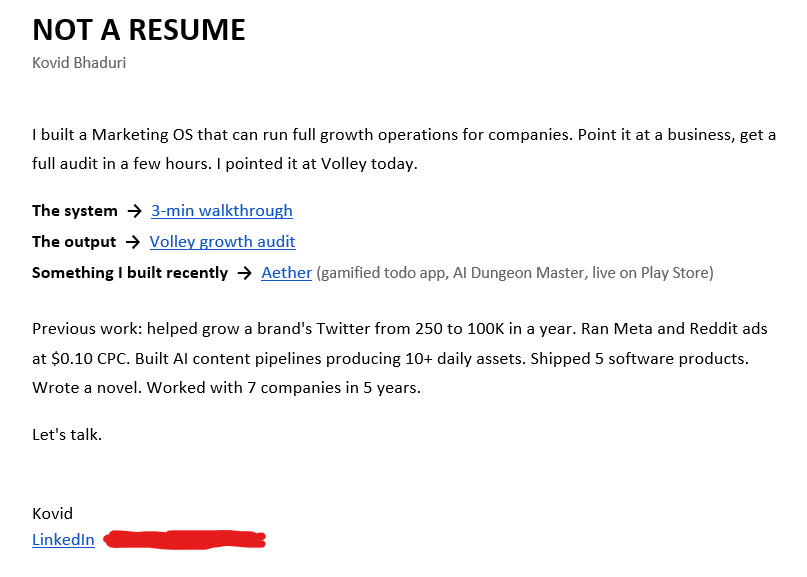
When I find a role I actually want, I send a not-a-resume instead. It’s a one-page document with three things: a piece of work I’d do for them in the first thirty days, an example of similar work I’ve already done with the real numbers attached, and a specific question for the hiring manager that proves I’ve read past the job description. No employment history. No skills list. No objective statement. Just evidence.
It works because it inverts the read. A resume asks the hiring manager to imagine what you might do. A not-a-resume shows them what you’ve already done and what you’d do for them next. The conversion rate is not close.
If you’re hunting in 2026, write yours.
If you’re building something that fits the shape of one of these five roles, or if you’re hunting and you want to compare notes, I’m at amikovid@gmail.com and @KovidBhaduri on X. kovidbhaduri.com if you’d rather read more first.
If you think the framing is wrong, tell me. I’d rather be corrected than admired.